
From Hong Kong Logistics Facilities to Large-Scale Developments: How Signage Becomes a Critical Communication System for Project Success

Hong Kong’s logistics facilities and large-scale developments are becoming more complex, connected and technology-driven.
Within these environments, thousands of people, vehicles, contractors, visitors and operational teams may need to move through different zones every day. They need to know where to go, what to do and what is happening around them — clearly, quickly and safely.
This is where signage plays a much bigger role than many people realise.
From large external signboards and wayfinding signs to digital signage, LED video walls and centralised content management, signage is no longer simply something installed near the end of a construction project.
It is becoming part of the communication infrastructure of the development itself.
A Logistics Facility Shows Why Signage Matters
Consider a modern logistics facility in Hong Kong.
Before a truck even enters the site, external signage may be needed to identify the development, entrances and different operational zones.
Once inside, directional and wayfinding signage helps drivers, employees, visitors and contractors navigate between loading areas, warehouses, offices, parking areas and other facilities.
Digital displays can communicate changing operational information, safety notices or important announcements. Large LED displays can provide high-visibility communication in major public or operational areas.
Different signage serves different purposes, but together they form a communication network across the development.
The same principle applies far beyond logistics facilities.
Transport hubs, government complexes, commercial developments, hospitals, universities, cultural venues and other large-scale projects all require people to navigate increasingly complex environments while receiving the right information at the right time.
Traditional Signage: The Foundation of Clear Navigation
Despite the rapid growth of digital technology, traditional signage remains the foundation of an effective signage system.
Building signs, large external signboards, directional signs, directories, identification signs and wayfinding systems provide information that needs to remain continuously visible.
For large developments, they help answer fundamental questions:
Where am I? Where should I go? Which building, floor or zone am I looking for?
A well-planned wayfinding system does more than install signs at different locations. It considers the entire user journey — from arrival and entry to major decision points and final destinations.
For architects and designers, this also means integrating signage with the architectural environment rather than treating it as an afterthought.
Materials, dimensions, typography, visibility, mounting locations, lighting and finishes all contribute to how effectively signage communicates while complementing the overall design.
Digital Signage: When Information Needs to Change
Not every message in a modern development should be permanent.
Operating information changes. Events change. Safety messages change. Visitor information changes.
This is where digital signage adds another communication layer.
Digital displays can be deployed at entrances, lift lobbies, reception areas, public spaces, transportation facilities and other high-traffic locations to communicate information that needs to be updated more frequently.
Interactive digital directories can also make wayfinding more flexible, allowing users to search for destinations or access additional information.
This leads to a simple but important principle:
Traditional signage communicates what stays. Digital signage communicates what changes.
For many large-scale developments, the most effective strategy is therefore not choosing one over the other, but designing both as part of the same communication system.
LED Video Walls: Communication at Architectural Scale
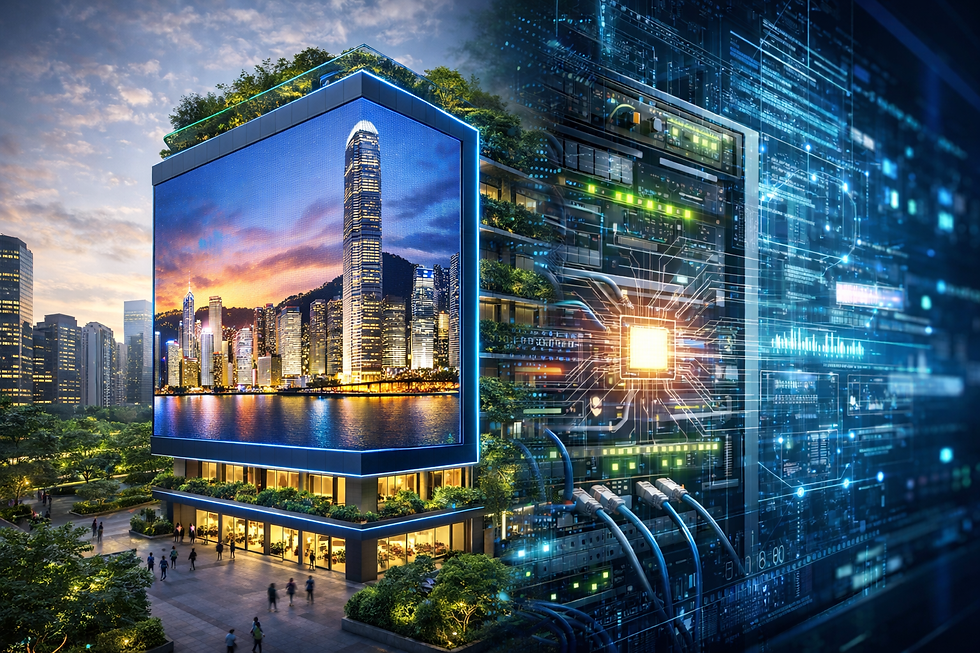
When information needs to be seen from a distance or create a stronger visual impact, LED video walls bring communication to an architectural scale.
Indoor, outdoor and transparent LED displays can be integrated into building façades, entrances, atriums, transportation facilities, event spaces and other large public areas.
They can serve multiple purposes — from public information and announcements to corporate communication, event content and visual identity.
However, an LED wall should not be considered simply as a large screen.
For architects, contractors and E&M consultants, factors such as viewing distance, pixel pitch, brightness, structural loading, power supply, network connectivity, ventilation, installation access and future maintenance can all affect the final solution.
This is why early technical coordination matters.
The earlier signage and display requirements are considered within the project, the easier it becomes to coordinate them with architecture, interiors, E&M and IT infrastructure.
From Individual Displays to an Integrated Communication System
As developments grow larger, another challenge emerges: how do you manage all these communication touchpoints efficiently?
A project may include dozens — or even hundreds — of traditional signs, digital displays, interactive directories and LED screens across different buildings and zones.
Installing the hardware is only part of the solution.
Digital signage and LED displays can be connected through Content Management Systems (CMS), AV systems and central control platforms, allowing authorised teams to manage information across multiple screens and locations more efficiently.
Content can be scheduled, updated and distributed from a central platform rather than managed screen by screen.
For building operators and facility teams, this can support:
Centralised content and display management
Faster information updates
Consistent communication across different locations
Scheduled messages and announcements
More efficient system administration
Easier future expansion and system upgrades
At this point, signage has evolved beyond individual products.
It has become an integrated communication ecosystem.
Why Signage Should Be Planned Earlier in a Project
Signage is often seen as one of the final packages in a construction or fit-out project.
But waiting until the final stage can create unnecessary challenges.
A digital display may require power and network points that were not originally planned. An LED wall may need additional structural support or ventilation. A sign location may conflict with architectural finishes, lighting, building services or maintenance access.
Late changes can mean redesign, additional coordination and potentially unnecessary variation works.
For construction companies, architects, designers and E&M consultants, earlier signage planning allows several requirements to be considered together:
1。Architecture and Interior Design
Signage locations, materials, dimensions and finishes can be coordinated with the overall design intent.
2。Wayfinding and User Flow
Sign locations can be planned around how people actually enter, navigate and use the development.
3。Electrical and Data Infrastructure
Power, network connectivity and control requirements for digital displays can be incorporated earlier.
4。Structural Coordination
Large signboards and LED installations can be considered alongside mounting and structural requirements.
5。System Integration
Digital signage, LED displays, CMS and AV control can be planned as connected systems rather than isolated equipment.
6。Maintenance and Lifecycle
Access for servicing, component replacement and future upgrades can be considered from the beginning.
The objective is simple: design the communication system as part of the project, rather than fitting it into the project afterwards.
One Development. Multiple Communication Layers.
Imagine moving through a large-scale development.
A large external sign identifies the development from a distance.
At the entrance, directional and wayfinding signage guides vehicles and visitors towards the correct destination.
Inside the building, traditional directories provide permanent location information, while digital signage communicates changing information and announcements.
An LED video wall provides high-visibility communication in a major public space.
Behind the scenes, a CMS and integrated control system manages digital content across multiple locations.
Each element performs a different function.
But together, they create a clearer and more connected user journey.
This is the direction in which modern signage is moving — from individual signs and screens towards integrated communication systems.
Building a More Connected Signage Ecosystem with Dynamax
For large developments, successful signage delivery requires coordination across design, fabrication, display technology, E&M infrastructure, system integration, installation and long-term support.
Dynamax Technologies provides professional signage and AV solutions across Hong Kong and Macau, covering:
AV and central control systems
System integration solutions
Design and consultation
Supply and installation
E&M project coordination
Maintenance and technical support
Rather than approaching each sign or display as a standalone product, Dynamax works with project teams to develop solutions that connect physical signage, digital communication and system infrastructure.
The Future of Signage Is Connected
As Hong Kong continues to develop smarter logistics facilities, transport infrastructure, public facilities and large-scale commercial developments, communication within these environments will become increasingly important.
People still need clear directions.
But they also expect information to be immediate, relevant and easy to understand.
Building operators need systems that can be managed efficiently.
And project teams need solutions that can integrate with architecture, E&M and digital infrastructure from the beginning.
That is why the future of signage is not simply about bigger signs or more screens.
It is about connecting the right signage, displays and technologies into one effective communication system.
Planning signage, wayfinding, digital displays or LED systems for your next development?
Talk to Dynamax Technologies about your project requirements — from design and technical coordination to supply, installation, system integration and ongoing support.


Comments