
From Screens to Systems: Why Digital Signage Is Core Infrastructure in the Smart City Era
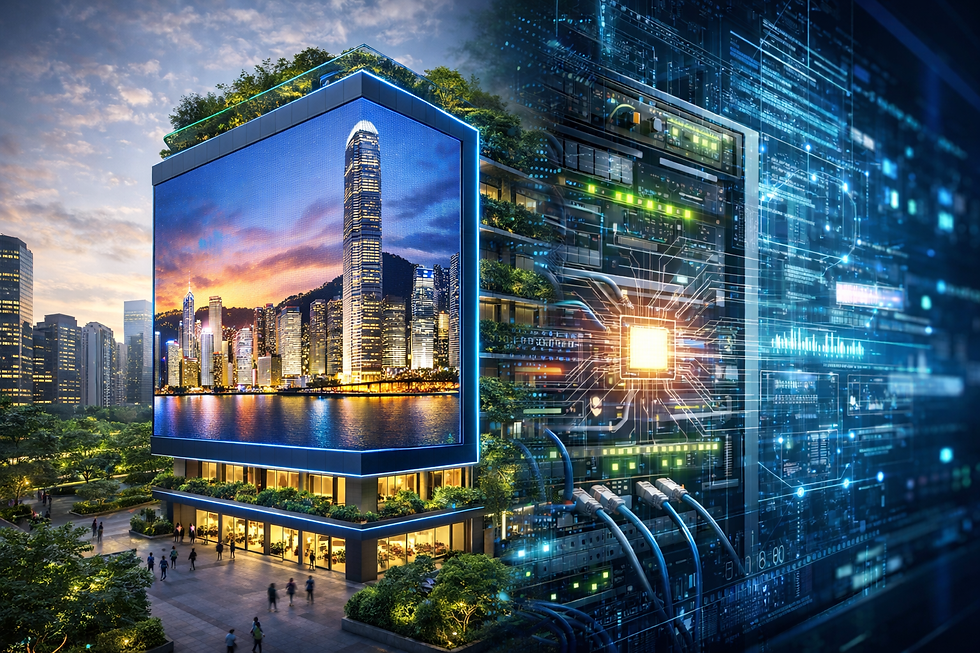
Buildings in the Digital Era
As cities move deeper into the digital era, buildings are no longer passive structures. They are becoming active communication platforms within a broader smart city ecosystem — connected, responsive, and data-driven.
In Hong Kong and Macau, this shift is increasingly visible across offices, shopping malls, transport-linked developments, and mixed-use projects. Digital signage has evolved from a late-stage visual add-on into a core layer of building infrastructure, supporting real-time communication,
wayfinding, operations, and user experience.
This change is redefining how digital signage is planned, specified, and integrated — from fit-out stage decisions to early base-build design.
1. From Screens to Systems: A Market Shift
Traditionally, digital signage was treated as standalone hardware — a screen mounted on a wall, disconnected from the rest of the building.
Today, modern digital signage functions as a system, integrating with:
Network and IT infrastructure
Centralised content management platforms
AV and control systems
Emergency and operational messaging workflows
In smart city-ready buildings, signage systems are designed to:
Deliver real-time information
Maintain visual consistency across spaces
Support multi-zone and multi-site control
Scale as buildings expand or change use
This is why digital signage is now discussed alongside power distribution, AV systems, and building controls — not after them.
2. Why Digital Signage Has Become Infrastructure
Several trends are driving this transformation across Hong Kong and Macau:
Smart City Development
As cities adopt smart infrastructure strategies, buildings are expected to communicate more efficiently with occupants and visitors. Digital signage plays a key role by enabling:
Dynamic wayfinding
Live announcements and alerts
Data-driven messaging
Integration with building operations
This aligns digital signage directly with smart city communication goals.
Larger, More Complex Developments
Modern developments are larger and more interconnected than ever. Mixed-use complexes, transport-oriented projects, and commercial hubs require signage systems that can function reliably at scale — something static signage alone can no longer support.
Rising User Expectations
In the digital era, users expect clarity, immediacy, and consistency. Buildings that fail to provide clear digital communication risk:
Poor navigation experiences
Higher operational workload
Increased tenant or visitor complaints
3. What Infrastructure-Level Digital Signage Really Means
Treating digital signage as infrastructure changes how it is designed and delivered.
It typically involves:
Early coordination with electrical, IT, and AV consultants
Defined power and data points at design stage
Integration with central control and monitoring systems
Planning for maintenance, upgrades, and lifecycle management
This approach ensures signage systems are:
Reliable over the long term
Secure and manageable
Flexible for future changes
Rather than being replaced every few years, systems can evolve — a critical requirement in smart city environments.
4. Where This Matters Most in Hong Kong & Macau
Infrastructure-level digital signage is now standard in:
Commercial office buildings
Lobby LED displays, tenant directories, meeting room systems
Shopping malls & retail complexes
Digital directories, promotional screens, interactive displays
Hotels & integrated resorts
Guest information displays, immersive LED features
Transport-adjacent developments
Real-time information displays, safety and directional signage
In these environments, signage is no longer decorative — it is operational infrastructure.
5. The Role of a System Integrator in the Smart City Era
As digital signage becomes infrastructure, the role of the supplier changes fundamentally.
System integrators are now expected to:
Design end-to-end signage architectures
Coordinate with consultants and contractors
Integrate signage with AV and control systems
Support long-term operation and maintenance
This requires expertise not only in displays, but also in AV integration, control systems, and lifecycle planning.
6. Thinking Beyond Installation: Lifecycle & Value
Infrastructure-level planning shifts focus from upfront cost to total cost of ownership.
Key considerations include:
System stability and redundancy
Ease of maintenance and component replacement
Software upgrades without hardware replacement
Scalability for new tenants or branding changes
In smart city and digital-era developments, signage systems must be designed to last — technically and operationally.
Conclusion: A New Baseline for Smart City Buildings
Digital signage has crossed a critical threshold. In the smart city and digital era, it is no longer an optional feature — it is a core building system.
For developers, consultants, and operators in Hong Kong and Macau, treating digital signage as infrastructure enables:
Better coordination
Better communication
Better long-term value
💡 Planning a commercial or mixed-use project? Engaging a digital signage and AV system integrator early ensures your building is designed for clarity, scalability, and future growth.
👉 Contact Dynamax Technologies for a free initial consultation!


Comments